
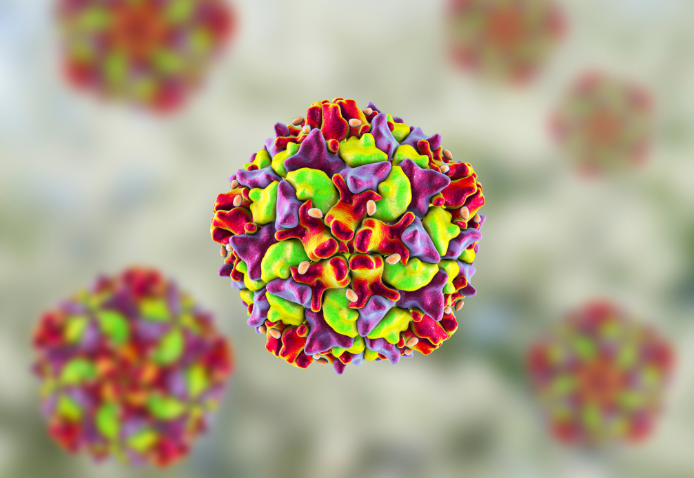
Poliomyelitis is an acute infectious disease caused by the poliovirus.
In about 0.5% of cases, the poliovirus moves from the intestine and affects the central nervous system, which leads to the development of flaccid paralysis, often incurable.
Poliovirus spreads from person to person through feces and saliva, most often through dirty hands, contaminated food and water.
Anyone can get polio.
However, the most susceptible to the polio virus are children under the age of five.
The incubation period after a person is infected with poliovirus lasts from 4 to 35 days, after which poliomyelitis can develop.
In 70% of cases, the disease has an asymptomatic course. But its carrier poses a danger to other people with weaker immunity.
In 25% of cases, polio has flu-like symptoms (fever, headache, nausea, abdominal pain).
Poliovirus causes movement disorders: pain in the affected muscles, complete paralysis, which can develop in a few hours.
Incurable paralysis is one of the most serious complications. It can affect the legs, arms, shoulders, chest, stomach, face. Damage to the respiratory muscles often leads to death. In the case of recovery after poliomyelitis, the functions of the affected nerves and muscles are not restored.
How dangerous is it?
The disease can occur both in a very mild form and in an extremely severe form. The first symptoms of poliomyelitis are a strong increase in body temperature, headache, runny nose, pharyngitis. Gastrointestinal disorders are possible. After a short period of improvement (2-4 days), a second wave of fever appears, the general well-being deteriorates sharply. After a few days, the patient suddenly develops paralysis. Most often, the disease affects the legs, less often paralysis of the muscles of the trunk and head occurs. In severe cases – paralysis of the respiratory muscles and diaphragm, which leads to impaired breathing and blood circulation.
Recovery of muscle function may take several months or years. But in many cases it is impossible to fully recover from poliomyelitis. About 5% of patients die, mainly from respiratory failure due to paralysis of the respiratory muscles. One in 200 patients develops such deformations of the spine and limbs that leave a person disabled for life. Other dangerous complications of poliomyelitis are pneumonia, atelectasis of the lungs, interstitial myocarditis, acute expansion of the stomach, severe gastrointestinal disorders with bleeding, perforation, ulcers, intestinal obstruction. Therefore, it is extremely important to remember about protection against poliomyelitis!
There is no cure for polio. The only effective protection against the disease is vaccination.
There are safe and effective polio vaccines - inactivated polio vaccine (IPV) and oral polio vaccine (OPV). The use of vaccines of both types provides the necessary protection of children both from the disease directly and from the possibility of becoming a carrier of the virus and infecting others. The effectiveness of vaccination against poliomyelitis reaches 99% - 100% in case of receiving a full course of vaccinations.
In 1988, governments created the Global Polio Eradication Initiative (GIIP) to rid humanity of the disease once and for all. The initiative is a global partnership involving national governments, WHO, Rotary International, the US Centers for Disease Control and UNICEF. Since the establishment of GILP, the number of polio cases worldwide has decreased by more than 99%, from 350,000 cases in 1988 to 22 and 33 cases in 2017 and 2018, respectively.
Polio is one of the few diseases that can be completely eradicated, as happened with smallpox. To date, types 2 and 3 of the "wild" polio virus have already been eliminated
on the planet. By eradicating polio, we will benefit children around the world, and no child will ever again have to experience the pain of paralysis caused by polio. Polio has no direct host (that is, it does not infect animals, and its virus cannot exist among animals, in the same way that malaria exists in, for example, mosquitoes); there is a safe and effective vaccine to protect children against polio, it does not survive for long in the environment, and although it is contagious, its infectious period is relatively short. Every year on October 24, the world celebrates World Poliomyelitis Day to remind the world community about the possibility of complete eradication of this deadly disease and the importance of its prevention through vaccination.